Mere Cui
Navigating Shifting Currents (Research Paper)
A Decade of Marine Species Migration and Climate Change in the Eastern Pacific
Research Summary
Climate change is reshaping how marine species move across the Eastern Pacific. This research combines NOAA datasets, ENSO cycle analysis, field observations from El Paredón, and geospatial mapping to examine shifting migration patterns in Eastern Pacific Green Turtles and Bull Sharks. The project integrates scientific data with lived experience, tracing how warming waters alter ecological rhythms, coastal livelihoods, and the spatial logic of marine life.
Key Findings
-
Rising sea surface temperatures are fragmenting long-established migration routes.
-
Eastern Pacific Green Turtles are rerouting or shortening migrations as coastal waters warm.
-
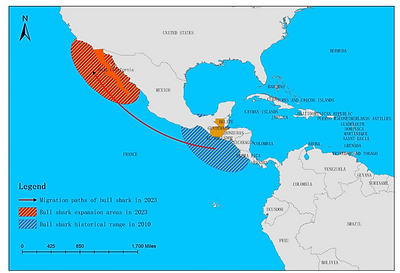
Bull Sharks show measurable northward expansion, intensified during strong ENSO years.
-
Field observations from El Paredón reveal local knowledge that mirrors climate data.
-
These shifting routes signal deeper ecosystem instability affecting prey, nesting, and livelihoods.
Methods
Climate Data: NOAA ERSST datasets, Coral Reef Watch products, ENSO anomaly analysis.
Field Observation: El Paredón beach surveys, local conversations, photographic documentation.
Visualization: Geospatial mapping, TouchDesigner thermal modeling, movement-logic translation.
Data Visualizations
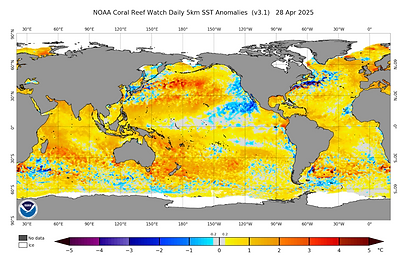
SST anomalies in the Eastern Pacific showing warming trends across ENSO cycles. (NOAA)
Marine heat stress and bleaching alerts across the Caribbean and Eastern Pacific. (NOAA Coral Reef Watch)
Increasing upper-ocean stratification limiting nutrient mixing in warming waters. (Sallée et al.)
Spatial variability in Eastern and Central Pacific ENSO events affecting regional temperature patterns. (Cai et al.)
Migration Maps
Migration paths are redirecting toward cooler or deeper waters as thermal conditions shift.
Green Turtle migration shift (2010 → 2023) Bull Shark northward expansion (2010 → 2023)
Field Observation: El Paredón, Guatemala
I documented quiet shorelines, faint turtle tracks, and irregular nesting signs.
Residents described species appearing at unusual times and in unfamiliar places.
These on-site observations echoed the climate data and revealed shifts visible in daily coastal life.
Discussion
Combined climate datasets, field observations, and spatial analysis indicate that migration in the Eastern Pacific is becoming increasingly temperature-driven.
Both species analyzed, the Eastern Pacific Green Turtle and the Bull Shark, show directional shifts that correspond with SST anomalies, ENSO variability, and habitat changes.
These patterns point to broader ecological restructuring as marine life adjusts to warming waters.
Download Full Research Paper
Navigating Shifting Currents: A Decade of Marine Species Migration and Climate Change in the Eastern Pacific
PDF · 37 pages · 2025